
Knock: ten or fewer.
Gin: exactly zero.
In classic Gin Rummy, you may knock when the cards left unmatched after your discard total ten points or fewer. Going gin means all ten remaining cards belong to sets or runs: zero deadwood.
Having a legal knock does not mean you must take it. You can keep playing to improve your hand.
What is deadwood?
A meld is a set of three or four cards of the same rank, or a run of at least three consecutive cards in one suit. Each card can belong to only one meld. Cards outside your melds are deadwood.
- Aces
- 1 point each
- 2 to 10
- The number on the card
- Jacks, queens and kings
- 10 points each
Aces are low: A-2-3 is a run, but Q-K-A is not.
Ten cards. Can you finish?
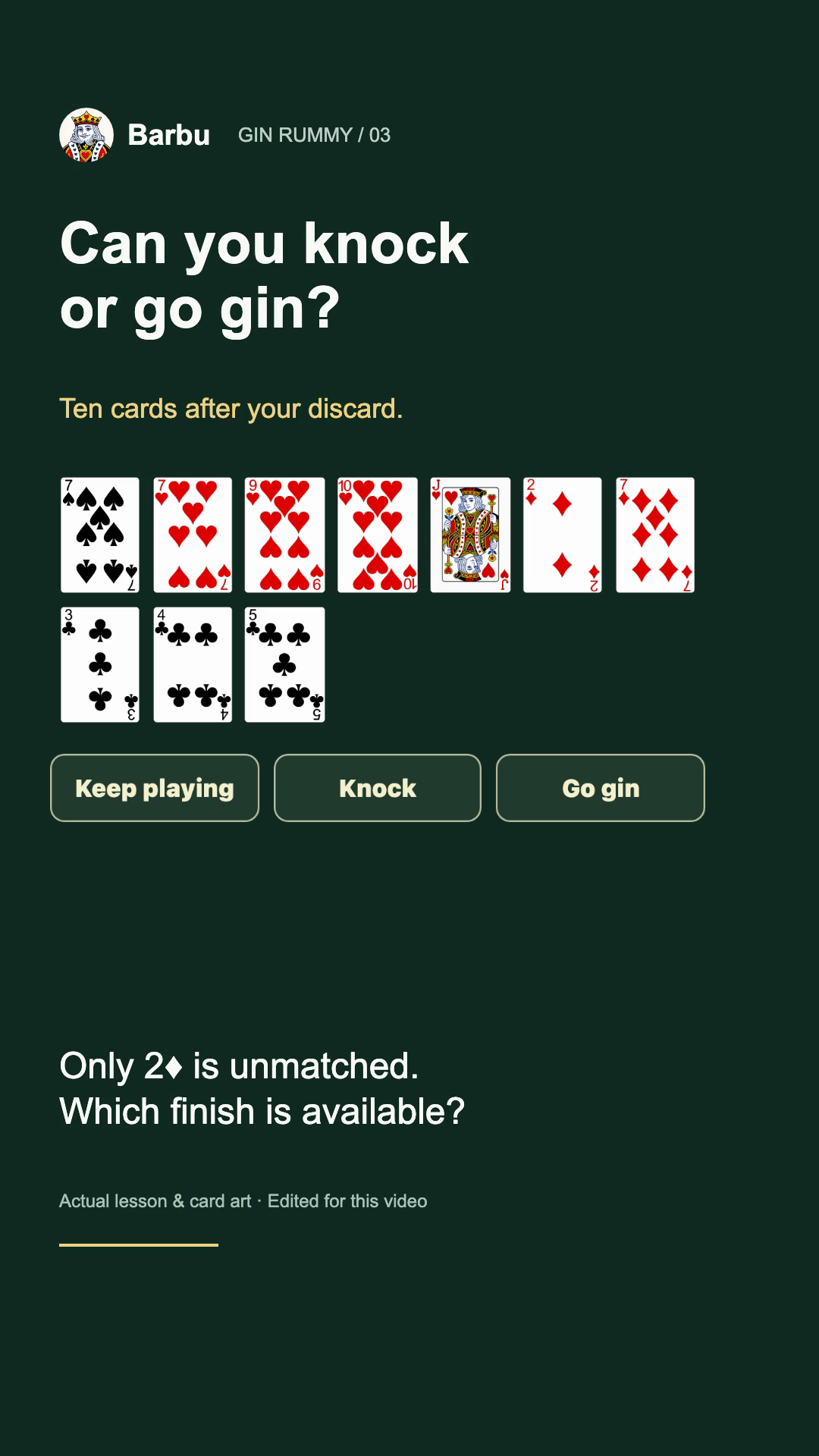
This is the hand from our short video, after the discard. Look for the combinations before revealing the answer.
Run in clubs3♣ 4♣ 5♣
Set of sevens7♦ 7♥ 7♠
Run in hearts9♥ 10♥ J♥
Unmatched2♦
Reveal the answer
You may knock, but you cannot go gin. The three melds cover nine cards. Only 2♦ remains unmatched, so your deadwood is two points. That is within the knock limit of ten, but not the zero required for gin.
Does a knock guarantee a win?
No. After a knock, your opponent can form melds and lay off unmatched cards onto your exposed melds. If their remaining deadwood equals or beats yours, they undercut you. There are no layoffs against gin.
This page explains the classic ten-point knock limit used in Barbu. Agree on your table's rules: variants such as Oklahoma Gin can change that limit.
Watch the card decision
A 24-second example from Barbu's Gin Rummy lessons, with the larger-card layout.
Try the next decision yourself
In Barbu, open Gin Rummy, then Learn. Start with Sets and runs, work through deadwood and finishing decisions, then try a guided hand against a computer opponent. Explanations help you connect each choice to the rules.
Gin Rummy lessons and play are free and ad-free on Android. Optional Premium games are separate. No online multiplayer.
Rules and further reading
Written by Martin Gullaksen, creator of Barbu. The worked hand is from Barbu's own learning exercises. For a fuller rules reference and alternative agreements, see Pagat's Gin Rummy rules. David Parlett also describes the history of Gin Rummy.